----------------

MrBagel Funny: Latest Joke Listed

MrBagel News: Hottest News Stories

Bodgey Bagels Latest Caption Contest

Mr Bagels Latest Cartoon

Mr Bagel Latest Videos

Friday, 10 November 2006

Outcry at stupid Stefaan's croc shock

Beware the crafty crocodile,
That cruises down the river,
Menace lurks behind his smile,
Enough to make you shiver !
Naturally you'll feel afraid,
These creatures fear not man,
Should you paddle, swim or wade,
They'll get you if they can !
Some wise advice - respect the croc,
And never play the fool,
Because an unexpected shock,
May lurk there in the pool !


Queensland, Australia

Locals are outraged that a tourist's stupidity, which led to him being attacked, will mean a popular crocodile called Allan will be moved away by rangers.

[click read more]

The two-metre croc will live out its days in a farm as a breeding crocodile after biting 24-year-old Belgian tourist Stefaan Vanthournout's leg when he tried to get its attention by wading into a creek and slapping the water with a stick.

The Queensland Parks and Wildlife Service has already sent out a team to search for Allan.

Mr Vanthournout was with a group of about six other tourists who ignored crocodile warning signs and went into Masons Creek, on the south side of Cape Tribulation in Far North Queensland, after spotting the saltwater crocodile lying on the riverbank.

The group waded to the other side of the creek and Allan slipped into the water.

The crocodile was submerged but Mr Vanthournout wanted to get a photo so he grabbed a 30-centimetre stick and started hitting the water so Allan would come up.

Come up he did, lunging at the Belgian and leaving a decent set of teethmarks on his left knee.

Queensland Parks and Wildlife Service spokesman Mark Read said Allan would have to be moved because "we have an obligation to ensure we minimise risks to all users, locals and tourists alike''.

But locals are upset Allan is being taken away.

The president of the Daintree Cape Tribulation Tourism Association, Alison Gotts, said the crocodile was being punished for the idiotic behaviour of a tourist.

"I just wish they would leave him alone,'' she said. "I don't think being tormented by an idiotic tourist warrants his removal. I am annoyed by the decision that the crocodile is the one who is punished.

"If you were being taunted by that tourist you would bite him too. No one here wants him to go, he has been here for about five years.

"It is his place, we are the ones that have invaded his space. We feel honoured to be living here with a croc.''

But Mr Read offered the theoretical situation of a child being attacked by Allan in the future as enough reason of the Wildlife Service's decision.

He said the farm Allan will be sent to has not yet been determined, adding it may take some time for the team to track down the crocodile.

After the attack one of the other tourists raced away to get help from the local pharmacy.

"We just had someone coming running in off the beach saying someone had been attacked by a crocodile,'' Kelly Lash, owner of the Cape Trib Pharmacy, said.

Dr Lash called an ambulance while his partner headed down to pick up the victim, whom he said was more shocked than physically injured.

"It just let go right away. He was sitting there in shock [and there was] a little bit of blood,'' he said.

"It lunged out and grabbed his knee and the worst part is he didn't get the photo.

"I tell you, it's a candidate for the Darwin Awards - the awards for doing stupid things.''

The Darwin Awards "salute the improvement of the human genome by honouring those who remove themselves from it'', says the awards' website.

Dr Lash said it wasn't the first time an animal had bitten Mr Vanthournout.

"The funny thing is his girlfriend told us he's been bitten by a monkey before.''

Mr Read said the tourist was extremely lucky not to have received more serious injuries.

"He's very lucky. The animal is estimated at two metres long and 70-85 kilograms in weight. Had the animal say bitten him on the face and then done a death roll, which is quite often part of their prey-catching behaviour ... normally there's a much higher degree of injury.''

Mr Vanthournout was treated at Mossman Hospital for his injuries but was released last night.

AAP reports: The Liberal Party last week passed a motion proposed by Senator Macdonald at its annual state convention in Brisbane for crocodile numbers to be reduced in populated areas.

The call came after crocodiles were spotted at The Strand in Townsville, forcing authorities to close the beach.

Senator Macdonald said croc numbers had returned to "sustainable levels'' since hunting was banned in Queensland in 1972.

"I think there is value to be obtained from the cull of wild crocodiles in the form of meat (and) skins - much the same as we do for kangaroos,'' he said.

But Queensland Environment Minister Lindy Nelson-Carr said destroying a "prehistoric animal'' which lived in Queensland was ``nothing short of ridiculous''.

She said most crocodile attacks occurred as a result of people behaving irresponsibly.

"This particular tourist behaved in a very foolish manner,'' she said.

"We have good signage, we educate the public to be croc wise and most people who have faced a crocodile under serious circumstances, where they've lost their lives, have been irresponsible because they've been drinking (or) they've gone into the water of known crocodile habitats after 5pm.''


References:

SMH: Outcry at stupid Stefaan's croc shock

Cartoon Caption by Bagelblogger.

Bagelblogger Fresh Always!
Technorati: * * * * * * * * * * * * Jewish * BagelBlogger * Bagel Blogger *
Read More...

Monday, 23 October 2006

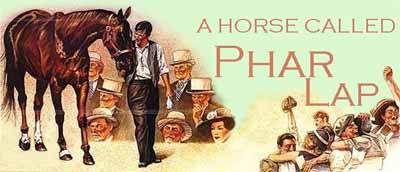
Phar Lap was Poisioned.


THE death of Phar Lap – Australia's greatest sporting mystery – has finally been solved.
Phar Lap triumphed during the Great Depression of the early 1930s, when a hero was most needed by the people of Australia. He conquered the local racing scene—36 wins from his last 41 starts—and then won North America's richest race, the Agua Caliente Handicap, in 1932. A fortnight later he went to the great equine heaven in the skies, struck down by a mystery illness that many suspected was the work of gangsters.

[To read how Phar Lap Died Click read More]

The Australia Daily Telegraph
has revealed that secret scientific tests using breakthrough technology have uncovered evidence the legendary racehorse was poisoned with arsenic just hours before his 1932 death in the US.

The startling revelation adds credence to the theory Phar Lap was killed on the orders of US gangsters, who feared the Melbourne Cup-winning champion would inflict big losses on their illegal bookmakers.

Scientists used a US synchrotron, or particle accelerator, to unlock the 74-year-old riddle of Phar Lap's mysterious death.

The proof lies in Phar Lap's hair.

A scientific report obtained exclusively by The Daily Telegraph shows a large dose of arsenic was ingested by Big Red about 35 hours before his agonising death in California on April 5, 1932.

"The arsenic in the hair structure is consistent with . . . a single large dose of arsenic," the report says.

The exact cause of his death was never proved, with suggestions ranging from the foul play theory to acute bacterial gastroenteritis.

But evidence of an arsenic overdose has been uncovered by scientists bombarding a strand of Phar Lap's hair with a beam of intense light.
"We've made observations which could be explained by poison," Australian Synchrotron Research Program scientist Dr Ivan Kempson told The Daily Telegraph. "We can't explain it by any other way."
Dr Kempson and Museum Victoria's Dermott Henry made the Phar Lap breakthrough by searching for minute traces of chemicals in the structure of Phar Lap's hair.
Hair incorporates blood products and these can provide a timeline of exposure to toxins that can be unlocked using synchrotron technology.
In 2000 the technology was used on six strands from a lock of Beethoven's hair to identify the cause of his illness and death – lead poisoning.
The latest CSI-style hunt to find what killed Phar Lap began in February last year when a sliver of hide was cut from his preserved skin.
The 2mm square sample was cut from beneath the mane. A whole hair was then removed from the sample hide and analysed at a synchrotron outside Chicago in June last year and June this year.
The tests revealed a high concentration of arsenic.
"The arsenic in the hair structure is consistent with . . . a single large dose of arsenic between one to two days prior to death," the scientists' report says.
The arsenic stretched about 900 microns along the hair from the root bulb, with a potentially deadly concentration found between 450 microns and 500 microns.
Assuming a growth rate of 1cm a month, the scientists estimated Phar Lap was poisoned 35 hours before he died. Tests on two more hairs produced the same results.
The behaviour of arsenic in the hair strand was also consistent with results from a test on the hair of a pig that had been poisoned with arsenic.
There were, however, some anomalies. Strong traces of arsenic found on the root bulb of Phar Lap's hair and hide produced a different chemical signature and were also associated with traces of lead.
Dr Kempson said this suggested it was a different arsenic that may have come from lead arsenate used to preserve Phar Lap's hide.


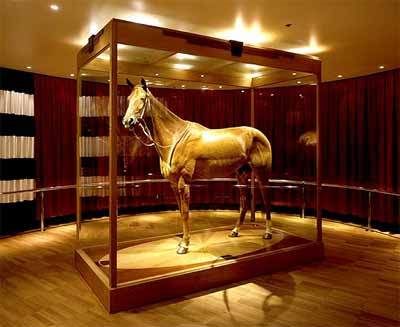
Phar Lap as he stands in the Victorian Museum


They hope to find another horse hide preserved around the same time to test this theory.
Arsenic was also detected on two hairs taken from Phar Lap by his owner before his death.
But only the post-mortem samples had traces of arsenic inside the hair structure that were consistent with the behaviour of ingested arsenic in the hair of the poisoned pig.
"You will never get a 100 per cent definite answer that you're confident there is no doubt about it," Dr Kempson said. "But we can't explain it by any other way than the scenario of poisoning."
On the morning of Phar Lap's death, trainer Harry Telford found him in severe pain and with a high temperature. A few hours later Phar Lap collapsed and died, blood spurting from his lungs as he haemorrhaged to death.
A necropsy showed his stomach and intestines were inflamed.
There have been many theories on what caused the giant five-year-old's agonising death, including accidental poisoning from lead insecticide.
But many, including Tommy Woodcock ,Phar Lap's devoted strapper ; remained adamant the champ had been murdered by US racing and crime interests who feared an unbeatable outsider.
But with no evidence, poisoning could not be proved.
A stomach condition caused by rotten or bad feed was widely accepted as the most probable cause.
In 2000, equine specialists reviewed two necropsies and concluded Phar Lap had probably died of Duedentis-Proximal jejunitis, an acute bacterial gastroenteritis formally identified in the 1980s.

BB:

Most Children who grow up in the State of Victoria, Australia are taken on an excursion to see Phar Lap at the Victoria Museum. Phar lap is still a stongly emotive subject, 74 year later. Most Australians feel he should have never been taken to the USA, this is where he was poisoned. It was thought he was poisioned by Gangsters worried about losing too much money on him racing.

Before his untimely death Phar Lap [Big Red] won 36 wins from his last 41 starts—and then won North America's richest race, the Agua Caliente Handicap, in 1932.

It was a time of serious depression, Phar Lap provided an escape from the drudgery of the time for working class Australian's, the death of Phar Lap shocked the Nation.

References and other reading:
Telegraph: Phar Lap death mystery solved
Wikipedia:Phar Lap
Par Lap the Legend: Museum Victoria

Bagelblogger Always Fresh!
* * * * * * * * * *s * * * * * * * * * Israel * Jewish * BagelBlogger * Bagel Blogger

Read More...